Staphylococcus aureus subsp. aureus USA300_FPR3757
f g x - functional genomics explorer
This site works best with recent versions of Chrome, Firefox, Safari, Opera, or IE9+

Visualization of Tn insertion clones using GView
GView is an outstanding SVG-based, zoomable interactive viewer for bacterial genomes. It is also very useful for visualizing a library of Tn insertion clones. The GView software is available here and the publication describing the software is available here.
The following static image (a .png file) was created using GView. As described below, this image shows all of the Tn insertions in S. aureus strain USA300 JE2 created in Dr. Bayles' laboratory (i.e., both the NARSA clones and the "extra" clones).
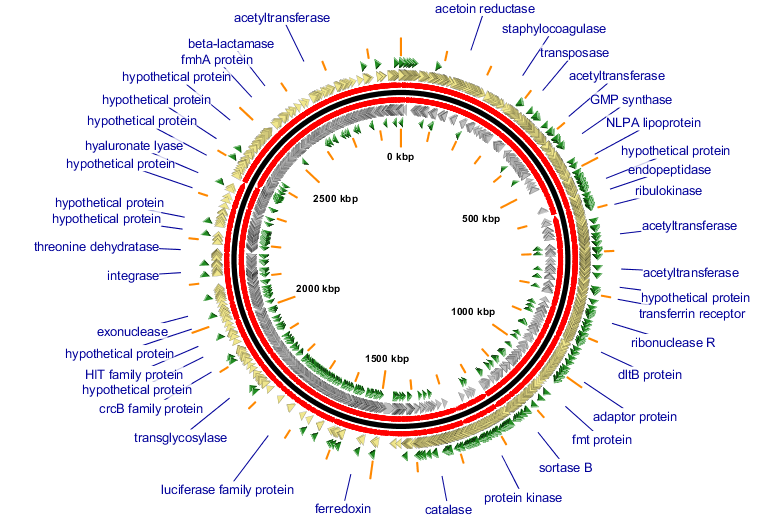
In order to use GView for visualizing Dr. Bayles' library of Tn insertion clones, a copy of the S. aureus USA300_FPR3757 RefSeq genome sequence (GenBank Accession NC_007793.1) was augmented by the ordered insertion of:
- Mapped Tn insertions using the “mobile_element” feature key, as described in the International Nucleotide Sequence Database Consortium (INSDC) feature table format; and
- A new (non-standard) feature qualifier (“/noTnInsertions”) in unaffected CDS genes.
Software written to accomplish the above task is available from Dr. Robert Boissy (see contact information tab) for use with any Tn insertion library, i.e., using that library's Tn insertion data and the relevant reference genome sequence.
The backbone (solid black line, centered) of the map shown above distinguishes GenBank annotations on the two DNA strands as follows:
- For the given (positive) strand of the GenBank sequence, annotations are shown outside the backbone, using clockwise arrows.
- For the reverse complement strand, annotations are shown inside the backbone, using counter-clockwise arrows.
GenBank-annotated genes are shown as arrows (gold or silver on either strand, as indicated relative to the backbone).
Tn insertions are shown as small red arrows, and are closest to either side of the backbone depending on the orientation of Tn insertion, which is defined relative to the transcription of Tn genes. The Tn insertions are so dense that they merge at the resolution shown.
CDS genes for which Tn insertion mutants were not obtained are shown using green arrows, and are shown furthest inside or outside the backbone (depending on their strand).
Although the static image shown above is helpful for illustration purposes, GView is far more useful when it is used in its zoomable interactive mode. This usage requires a suitable GView style sheet and an appropriate annotation input file (in either GenBank or GFF format). A suitable GView style sheet, and three different GenBank-formatted input files of Tn insertion clones in S. aureus strain USA300 JE2 (i.e., that were mapped using the USA300_FPR3757 genome sequence), are provided below as compressed (.zip) files for download, decompression (i.e., using decompression software of your choosing), and then subsequent visualization using GView.
- GView style sheet for INSDC feature-table-style Tn insertion data added to GenBank-formatted files.
- S. aureus USA300_FPR3757 RefSeq GenBank file (Accession NC_007793.1) augmented by mapped NARSA Tn insertion clones.
- S. aureus USA300_FPR3757 RefSeq GenBank file (Accession NC_007793.1) augmented by mapped "extra" Tn insertion clones.
- S. aureus USA300_FPR3757 RefSeq GenBank file (Accession NC_007793.1) augmented by all (NARSA and "extra") mapped Tn insertion clones.